|
| The Mercedes Benz O405G Hispano Carrocera MK I demo : TIB838H. |
To meet the growing population and demand on public transport in Singapore, the Land Transport Authority (LTA) allowed the trial of articulated buses onto Singapore roads. One of such buses brought in for the trial was the Hispano Carrocera O405G demonstrator TIB838H by TIBS, affectionally known as "The Bendy Bus".
TIB838H was registered together with the Scania L113CRL 'ELBO' buses range (TIB833X to TIB848D), and '838' is an auspicious sounding number. It is also the only bus to date to be airflown in by a cargo plane to Singapore from Spain in 1995/1996.
 |
| TIB838H when it was newly registered with TIBS (Photo from old TIBS website, courtesy of Trans Island/SMRT Buses) |
An articulated bus consist of two sections being joint by a turntable at the middle, essentially creating a long bus to two section. This allows for larger carrying capacity in a single deck bus as compared to a regular 12m single decker. It can turn in the middle via the turntable for easy maneuvering around corners and bends. The entire SMRT Buses' O405G fleet are pusher bendies, in which the engine mounted at the rear "pushes" the bus forward via the trailer drive axle.
TIB838H's first service saw it plying on old service 171. The trial was successful and a fleet of O405Gs were eventually purchased, variations includes the modified MK II bodywork, the smart looking Hispano Habit bodywork by
Pininfarina and a small number in Volgren bodywork
 |
| A MK II bodyworked O405G |
 |
| The smart looking Hispano Habit bodyworked O405G |
 |
| The Volgren bodyworked O405G |
There will also be hyperlinks that link some of the bendy's feature to their rigid cousins and to some photos of the bendy that links to the particular topic of interest.
Exterior
 |
| TIB838H on its permanent service 180. |
The entire bendy does look like a stretched version of the 12m Hispano Carrocera O405, as it carries most of the design elements/features over to this bodywork. The entire bodywork looks very similar, save for the side passenger windows being shorter in breadth to give an illusion that the bus is longer by having more windows.
The feature of opening a single door leaf is
carried over.
 |
| A carried over feature - one door leaf opening. |
 |
| The articulator of the bus - bus is fully 'bent' to the left. There is an extra signal indicator on both left and right of the bus before the articulator for extra visibility for the road users. |
The third door which is located after the articulator helps to offload passengers faster.
 |
| The rear nearside is also similar to the O405s. |
The right side of the bus.
 |
| A stretched version of SMRT's O405! |
 |
| With the shade, it does look O405-ish. |
 |
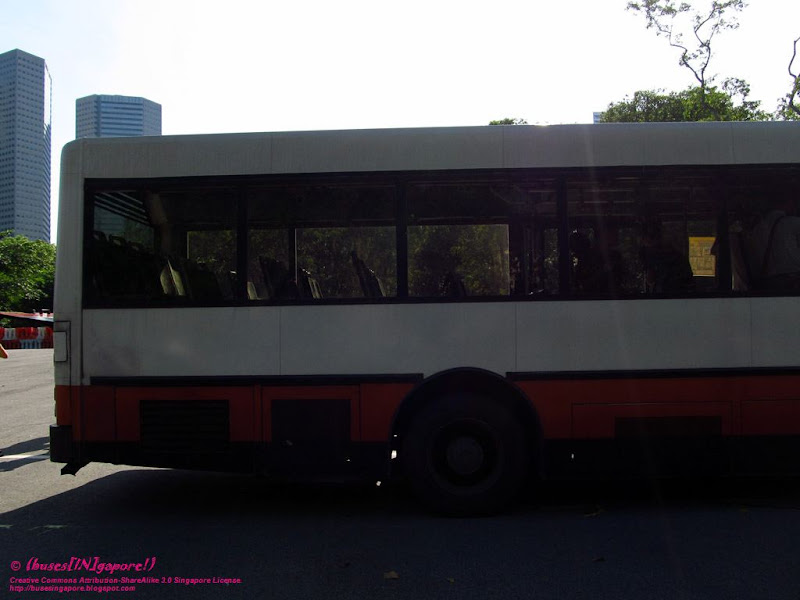
| Same design cues here on the offside. |
 |
| The cooling unit and the battery system. |
The rear is the part where it designed differently from
the rigid Hispano Carrocera O405s, though it retains the general look. There is a 'Long Vehicle' and warning stickers at the windows/bumper to caution other road users of this long vehicle.
 |
| The rear of TIB838H. Same taillamp sets are used. |
 |
| The rear sees a larger window encompassing the entire top half of the bus, integrating the two night lamps into the bus body and having strips for a more distinct look. Some buses have the strips removed for a cleaner look. |
 |
| At the time of introduction, it was the first bus with a rear flipdot signage, mounted above it is a camera to enhance the awareness of the driver while driving. |
 |
| The power is derived from a Mercedes Benz OM 447 hLA engine that is coupled with a ZF4HP590 gearbox. However, the rigid and the bendy version sounds very different, with the O405G having a higher pitch. |
 |
| The full length of the articulated bus is 17.5m. Despite its length, it is able to navigate around turns quite comfortably. |
Interior
The interior of TIB838H is
very similar to its rigid cousins such as the aircon ducting, interior lighting design and the minimalist partion interior. The Arianne buckets seats were not originally part of the specifications, but TIB838H recieved it likely due to the then-purchase of the Scania ELBO buses that uses the same seats during the same timeframe.
 |
| The interior of TIB838H |
In the front half of the bendy:
 |
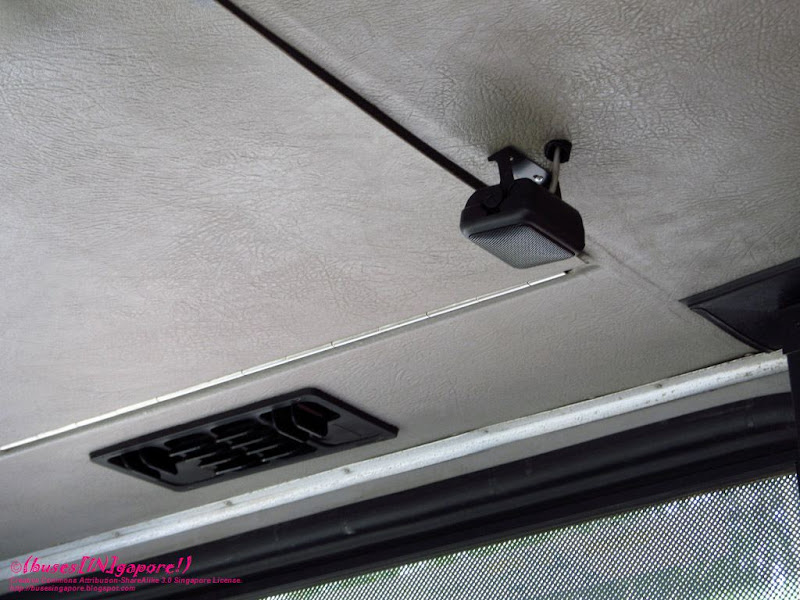
| Above the entrance door and the two other exit doors, there are adjustable aircon outlets. In the production models however, these are just vents. |
 |
| A small monochrome TV allows the bus captain to monitor the rear/exit door at the trailer section. |
 |
| The door control switches.. |
 |
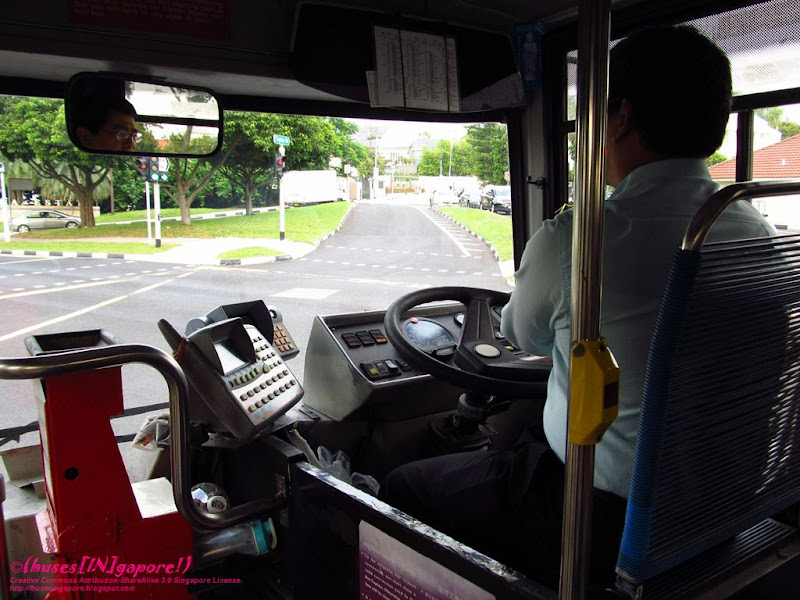
| The Konvekta aircon controller and the Hanover controller above the driver's cabin. |
 |
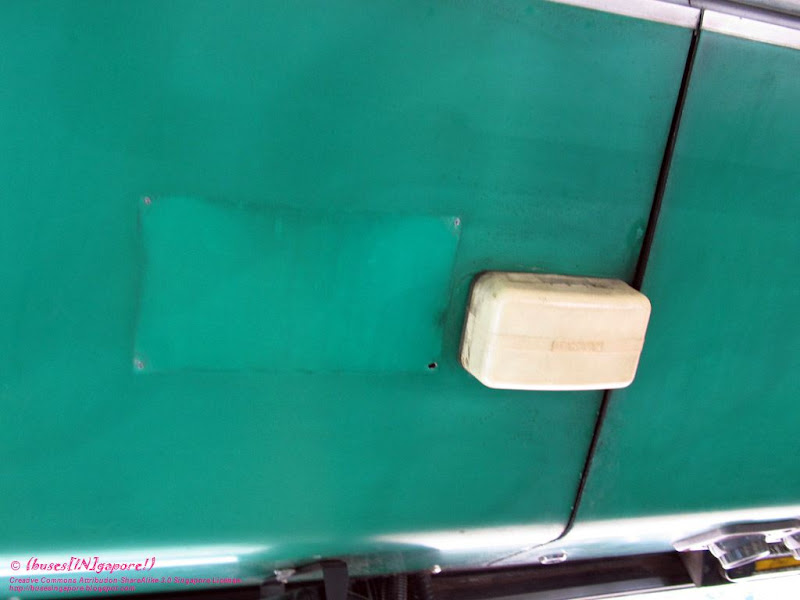
| The bus stopping bell, together with an empty space that used to hold a "licensed to carry" plate. |
 |
| The old Farecard machine. It is now a big ticket dispenser due to the phasing out of farecards. |
 |
| The front half of the bendy. Note the rear half of the bendy in the background on the right. |
 |
| The right single seats.... |
 |
| ...and the left single seats.... |
 |
| ....allows for a larger floor space for more passengers. The single seats' design are actually the original seats installed on TIB838H. On some bendies, twin abreast seatings are installed instead of single seating for this front portion. |
 |
| Arianne bucket seats mounted on the "platforms" above the second axle. |
 |
| The 3 bus stopping indicators in the front, middle and at the trailer carriage's positioning are carried forward from the O405s design. In the production models, it was specfied to white casing with red LED lighting "BUS STOPPING". |
The articulator
 |
| The articulator sees the bus having two grab poles in the middle. On the production model, it has only one grab pole. The brown walls of the articulator allows for standing passengers to lean against it. |
 |
| The bendy bends with the "curtain" squeezed |
 |
| While the "curtain" fans out towards the non-bent area. |
 |
| Airconditioning is provided to the articulator area via this outlets at the end of the duct, with each duct there are there are two outlets, making it a total of 8 outlets. |
 |
| The hint of wear and tear, together with the dust and dirt can be seen in this pic. |
In the back half of the bendy:
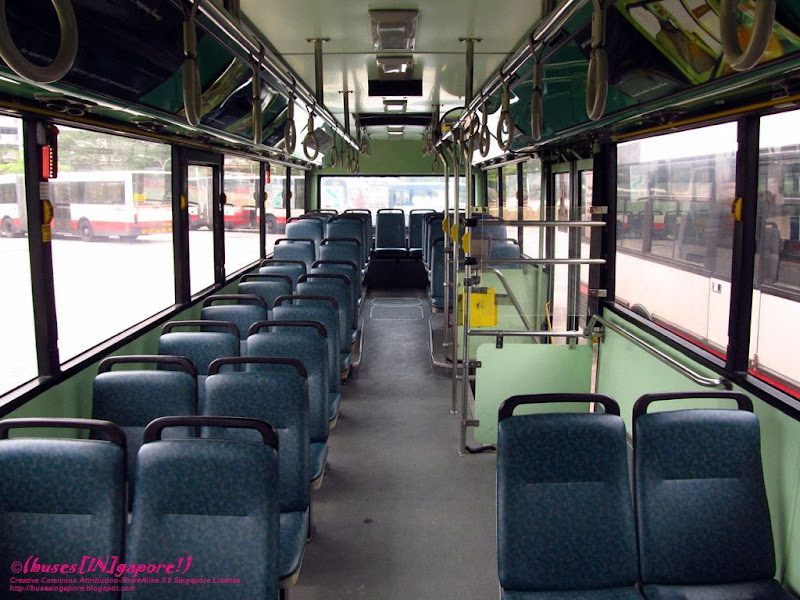
 |
| The rear half of the bendy with a standard seating arrangement that would be carried over to the production model. |
 |
| Except for this lone seat and a grab pole. In the production models, this seat is not present, with the seat behind it moved forward and gaining a slightly larger legroom. |
 |
| The third door designated as the second exit for faster disembarking of passengers. |
 |
| The exit door's aircon vents, door closing and the camera for the CCTV system. |
 |
| The last row of seats at the front and this rear half of the bendy have this very small armrest installed. |
 |
| The rear row of seats seems higher than the O405s |
 |
| The view of TIB838H's interior from the rear. |
As TIB838H heads out for its mid-life refurbishments, which will see some of its unique features upgraded/removed. These unique features of the bus would have been documented by many, both on pictures and in memories.
Misc
TIB838H only bendy with key startup, while the other bendies have keyless startup.
 |
| The Hispano Carrocera and bus identification plate |
 |
| Thank you for moving back. Courtesy advertisement from the old TIBS days. |
 |
| Electro Static filter. |
 |
| A night lighting showing the ambience of the green colour interior. |
 |
| A half refurbished Hispano Carrocera bendy's interior which sees the seat covers replaced to SMRT's colours. Note the front section of the bus with twin abreast seating, and the middle grab pole. |
 |
| A wholly refurbished Hispano Carrocera bendy, with the single seats arrangement. TIB838H is expected to be refurbished to this, though which features will be retained or removed remains to be seen after its refurbishments. |
Further reading on the Hispano Carrocera O405s @ http://busesingapore.blogspot.com/2011/02/smrt-buses-mercedes-benz-o405-hispano.html
![(buses[IN]gapore!)](https://blogger.googleusercontent.com/img/b/R29vZ2xl/AVvXsEhUpjEgfDeX7ZRuyhQk4VapcK_2fcn9NuFErwExXDh3UvvrxmuTXtE5VjYg4Itwh1lvuoc9GJov59Gp9pP8M4F4LTOlG9a5bOegFLroEieij6b4Yshorh7ks7cGVjxxaFwK9zE8dOtBpQ/s800/DSC_8122.jpg)