When it was unveiled back in 2010 that a Citaro will be on trial with SMRT Buses', it generated alot of excitement as such bus of this prestige was not expected to be in service in Singapore. SMB136C was unveiled at a SMRT press launch with much fanfare.
>> Do read here for a background of SMB136C, the Citaro demonstrator!
 |
| The first Citaro in service in Singapore, SMB136C |
The bus was touted as the 1st 100% fully low floor Euro V bus, and officially went on trial on 16th March 2010 with SMRT Buses. Fast forward a year later, the production Citaros are now on service on Singapore roads, with the trial concluded as successful (there is another
MAN fully low floor demonstrator in service now). There are currently 10 production units brought into service with SMRT Buses, while SBS Transit had made an order for 300 Citaros.
At first glance looks similar to the Citaro demonstrator (though nobody saw SMB136C in revenue service with SMRT Buses livery, given it was stuck with the promotional ad during the trial ^^).
 |
| The beauty of the Mercedes Benz Citaro |
The bodywork's elegant curves and styling, together with the simple red/black SMRT livery seem to compliment each other, giving the bus a very attractive appeal.
 |
| The side EDS now contains route details. |
The most significant change is the front orange LAWO electronic destination signage (EDS), from the demonstrator which uses the Gorba EDS system. The side EDS have been moved forward and lengthened to accommodate both the display of route number and direction/route details.
Other changes in the production batch :
- The exit door's height was lengthned to a bigger door on the exterior. It now uses a plug door system.
- The white airconditioned pod instead of grey from the demonstrator.
- No hopper windows are specified, instead it uses full length windows.
 |
| The slightly out of place dot ^^. |
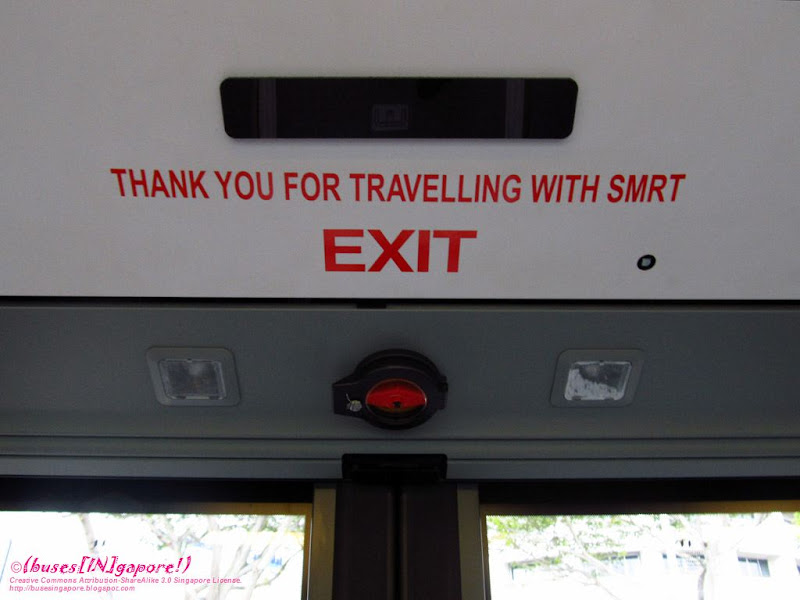
The slightly out of place black dot opens the front doors normally, as turning the emergency lever on the side of each doors will release the air rendering the doors inoperable unless the air is recharged.
 |
| The rear of the Citaro. Simple yet stylish. |
The rear of the Citaro is the same as the demonstrator, with the secondary brake lights integrated at the top of the rear. Though oddly the Citaros are not equipped with LED tail lights for better visibility, instead opting for conventional bulbs. The LAWO EDS is located above the rear window.
 |
| The right side of the Citaro, simple, classy and attractive. |
The right of the bus is simple, classy and attractive. There is an additional right blinker specified above the rear wheel on this side for better visibilty of the signal lights when the bus is exiting bus bays. One word to sum the exterior : It's breathtaking, especially together with the minimalist SMRT red and white and black livery.
(Author's note: I did not expect SMRT Buses' livery and the design/styling of the Citaro to compliment each other this well. It's breathtaking. It is a good thing that SMRT Buses kept the actual look under demonstrator's advertisment ^^)
Interior
The interior of the production batch Citaro is very similar to the demonstrator, save for a few differences. The first thing that you'll notice is the familiar SMRT's blue/purple and red with grey colour scheme.
 |
| The interior of the Citaro production batch. |
Like the Citaro demonstrator, it comes with the standard Citaro seats, though the difference is the use of the blue/purple and red seat covers instead of the red fabric seat covers in the demonstrator. It did arrive with the factory-installed red fabric seats before being changed.
 |
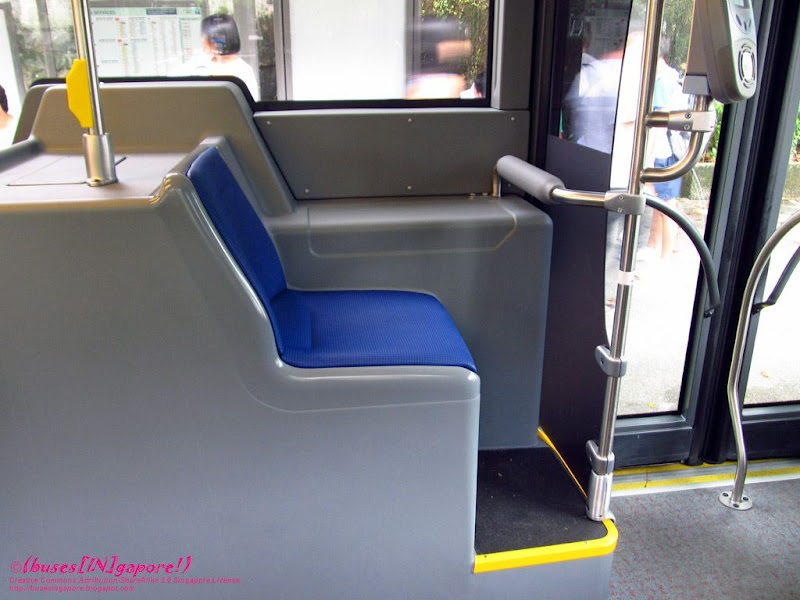
| The seat above the wheelarch, with an additional pole in front to allow easier access to the seat. |
 |
| The wheelarch seat behind the driver's seat. |
The seat above the left and right wheelarch is not designated as a piority seat, and can accomodate one passenger.
 |
| The doors of the Citaro. |
The poles that manipulate the front door's opening and closing are hidden entirely from the passengers, minimising the passengers accidentally holding on to it as a grab pole and damaging the door mechanisms.
 |
| The fire extinguisher is located besde the coinbox, and somewhat looks a bit out of place without the cover as seen on the demonstrator. |
 |
| The driver's office. |
The door buttons are not placed on the right of the driver, but instead are on the left.
 |
| The front/rear doors opening buttons are located on the left. |
The driver's compartment/dashboard is also simple and elegant, and very ergonomical. The doors opening/closing buttons are located on the left.
 |
| PIS showing Bus Stopping.. |
 |
| PIS showing Welcome Onboard. |
The Passenger Information System (2nd gen "PIS") doubles up as a Bus Stopping/Welcome Onboard messages apart from its primary purpose of providing the next stop information. There are no independent bus stopping lights found at the front or the middle of the bus; if the PIS malfunction there are not much indication to the passengers that the bell was pressed.
 |
| There are extra airconditioning vents |
 |
| On both side of the bus. Also of note is no more destination signage equipment. |
There are extra aircon vents at the front half of the bus, presumably to aid in the flow of the airconditiong. Though these are missing in the rear half of the bus. Though overall, the air-conditioning flow seems not to be as strong given that it is still pushed out via multiple tiny airconditioning slots.
 |
| The wheelarch seat. On the left wheelarch are two standard seats,while this is in one "single" seat but can accomodate two passengers. |
 |
| Stickers to remind passengers to hold on to the grab poles (and handgrips), with a reminder to move to the rear. |
 |
| No Smoking/Move to the rear |
 |
| No ice cream, snacks and soft drinks allowed either ^^ |
 |
| There is a new yellow marking to mark the handle's position and to prevent people from accidentally walking into the pole. The foldable seat is still there, with the red cushion as the headrest, and seatbelt for safety. |
The new plug doors are the standard feature found on new buses today. Oddly it is not a sliding plug door system. But this plug door system does have a flair of its own while closing!
 |
| Doors opened. |
 |
| When the doors are closing, it turn inwards before plugging in back to the bus body. |
 |
| Closed. |
 |
| Exit! |
When viewed from the interior...
 |
| Doors are closing.... |
 |
| *titititiititititit* (note the inward turn of the door leafs) |
 |
| Doors closed. |
 |
| PIW ramp. |
 |
| Addition of this light strip that says "Doors Closing" at the door. |
 |
| From the middle to front view. |
Towards the rear half of the bus.
 |
| The rear half of the Citaro |
The left side of the rear half has one seat that will leave our feets dangling. In the demonstrator, it was a lowered and higher seat side by side due to the slightly lower floor for the platform seating area.
 |
| "Conference" seats. The outermost seat on the left is higher. |
 |
| The seat is actually higher above the floorline. |
 |
| This outermost seat in the foreground leaves our feet dangling in the air. |
 |
| The right side however, does not suffer from the same issue of a seat being higher than it should be. |
 |
| Part of the engine components are inside here. |
 |
| The 4 seats at the rear row, with a seatbelt in the middle row as a safety feature. |
 |
| The rear window |
Misc.
The announcements are quite loud in the rather quiet interior that the Citaro.
 |
| The speakers work! SMRT's announcements are played through these speakers located in the bus. |
 |
| Only for emergency uses. |
 |
| The Citaro's front - stylish and elegant. |
The Mercedes Benz Citaro does lives up to its prestige and class as expected! The ride and comfort is very comfortable, though the airconditioning could be a bit stronger.
 |
| The Mercedes Benz Citaro - a crowd's favourite. |
Wholeheartedly recommends the Citaro for a ride along any routes!
![(buses[IN]gapore!)](https://blogger.googleusercontent.com/img/b/R29vZ2xl/AVvXsEhUpjEgfDeX7ZRuyhQk4VapcK_2fcn9NuFErwExXDh3UvvrxmuTXtE5VjYg4Itwh1lvuoc9GJov59Gp9pP8M4F4LTOlG9a5bOegFLroEieij6b4Yshorh7ks7cGVjxxaFwK9zE8dOtBpQ/s800/DSC_8122.jpg)