It all started with this bus. Without it, there'll probably be no SMB388S today.
 |
| SMB138Y when it was newly introduced into service |
SMB138Y, the first ever MAN NL323F A22 low floor bus with a public transport operator (SMRT Buses). Bodied by MCV with the eVolution bodywork, it had a 1 year trial and was successful, resulting in the production variant being brought in.
SMB189A was the first production unit to be brought in, bodied by Gemilang with the Lion's City Hybrid design that is licensed from MAN. Apart from the bodywork design being different, the use of Mobitec electronic signage and the change of the door systems from Ventura (SMB138Y - slower exit door closing) to Masats (with a faster exit door closing), the specifications for SMB138Y and SMB189A (and other production vehicles) are near identical.
 |
| SMB189A awaiting inspection before registration - the first production unit of MAN NL323F A22. |
 |
| SMB138Y and the production batch meets~ |
Though the layout is near identical, the production batch lacked one crucial feature from the demonstrator - something to grab on after the wheel arch seat for standing passengers. So SMRT Buses rectified it in the later batches registered under the 13XX series with the modified specifications.
 |
| SMB138Y's interior |
 |
| SMB189A's interior (the rear half was modified to become 100% low floor minus the step later on when the bus entered service after a while). |
 |
| In the SMB13XX series MAN NL323F buses, there are additional grab handles poles at after the driver cabin, wheelarch seats area and at the first pair of front facing seats. Additionally, this unit SMB1341C has a single seat arrangement for what used to be two pairs of front facing seats on the right side, the only unit as of post date to have this configuration. |
Given the success of the NL323Fs, it wouldn't be a surprise if SMRT Buses brought in a MAN bendy bus. It's analogues to how TIBS brought in the Hispano bodied Mercedes Benz O405 in large numbers and later the first ever bendy bus, a Mercedes Benz O405G registered as TIB838H was brought in, bodied with the same Hispano bodywork.
 |
| The MAN NL323F A22 and the Mercedes Benz O405 of the SMB and TIB (Trans Island Bus Service) era of SMRT Buses meets. In some ways, both buses are analogues in terms of comfort, power and appeal, and later resulted in an articulated version of the type to be brought in. |
 |
| From Trans Island's official website - TIB838H when brand new. |
 |
| TIB838H when it was still in service, about 1 and a half years before it was retired and scrapped. |
 |
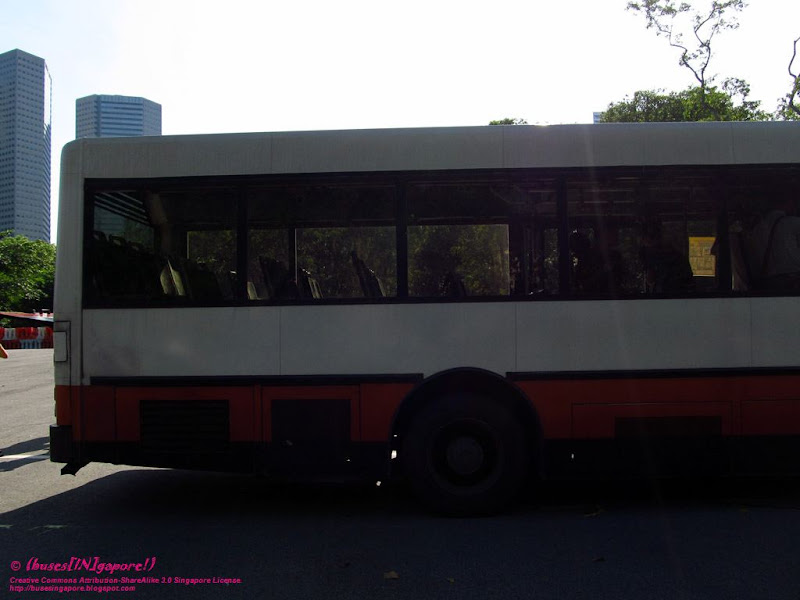
| The production Hispano (MK I) bodied O405G with its rigid O405 cousin. |
As TIB838H was reaching its 17 years end of lifespan, a replacement bendy bus was brought in - and the articulated version of the NL323F A22, the NG363F A24 was brought in.
Initially delivered without a plate, it was trialled and tested for a few months (probably) before being fitted with a unique plate prior to registration - SMB0000W. It's not an official plate, but a plate used for promotional shoots and stuffs like that and about the same time it also went for vehicle inspection for registration. Do check out this
MAN Singapore webpage to see PA0000P and other 0000 plates in the photos.
 |
| Much as everyone loves this unique registration plate SMB0000W, it's not an official plate due to the number 0000 and cannot be registered - the checksum is also wrong, it should be 'K'. |
 |
| Yeah, not photoshopped, SMB0000W - it's real~ |
Later, it was registered as SMB388S - the same auspicious lineage of the registration for TIB838H (which was specifically reserved in the ELBO bodied Scania fleet registration range between TIB833X to TIB848D). Perhaps a tribute?
 |
| SMB388S undergoing driver familiarisation~ |
 |
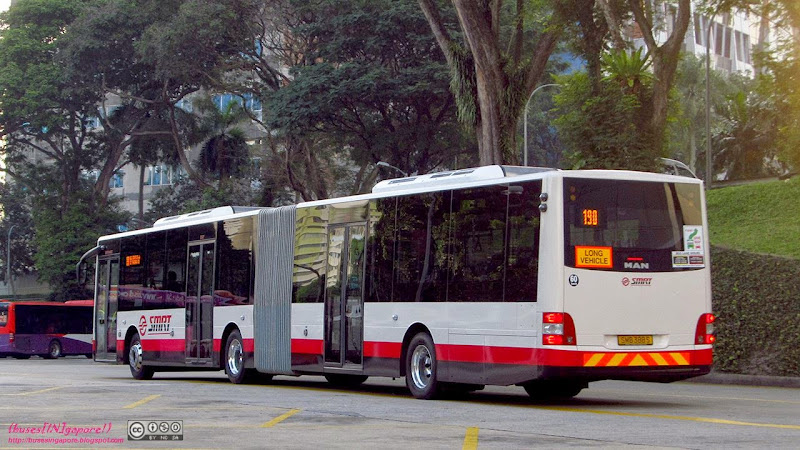
| The rear of the bus as it leaves 313@Somerset on its training route (said to be training for service 190 bus captains). |
Bodied by Gemilang, the design + bodywork parts is standardised with the NL323F buses. The bottom half of the entire bus is essentially an elongated MAN NL323F bodywork with an articulator strip in the middle, while the top half has no Hybrid "hair" configured. Essentially, a Lion's City G bodywork except it's a bit taller than the standard Lion's City G. Not sure why though, and it's apparently marketed as "Lion's City GL". It is fitted with the same Masats door system like the NL323F buses.
And instead of Mobitec signage fitted on the MAN NL323Fs, it is equipped with Gorba electronic signage, except that the side is now fitted with a bigger unit that can display route details unlike the Mercedes Benz O405G buses with upgraded Gorba signage with a side display only able to show route number,
The exterior is equipped with 3 LED side blinkers per side, while the rear has the same LED tail lamp configuration as its NL323F cousins.
It's also the first public bus in Singapore to be equipped with Spheros airconditioning system.
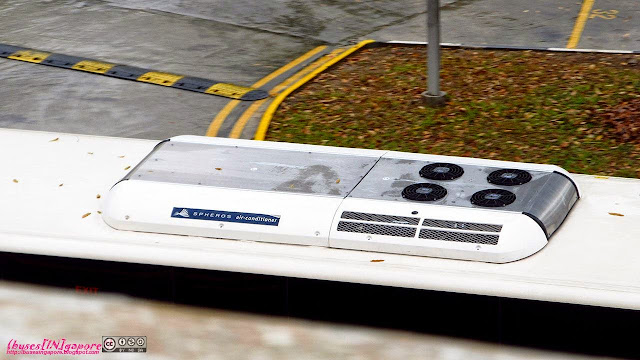 |
| Spheros airconditioning system - top view. |
 |
The MAN Lion's City G - It looks more stocky and shorter than SMB388S - and more solid looking too.
(Photo source : euregiobus.de, used for the purpose of illustrating the MAN Lion's City G bus) |
 |
| Offside of SMB388S on the first day of service on 190 plying between Choa Chu Kang & New Bridge Road. |
Once on board SMB388S, well....the excitement of a new bendy bus wears off very quickly.....>.<
 |
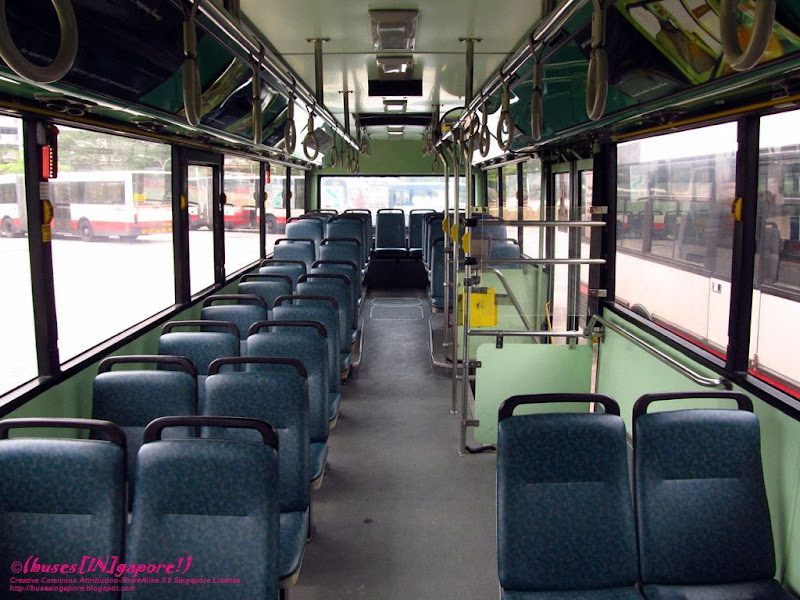
| We've seen this before somewhere.....oh, earlier on in the article, SMB1341C's interior (missing two chairs). Except this is longer. |
The interior of SMB388S is almost the same as the SMB13XX series MAN NL323Fs, what one would be seeing if he/she regularly boards a MAN NL323F A22. The only difference for the front half is that it has 2 pairs of front facing Vogelsitze per side instead of 3 pairs before the wheelchair bay/exit door - due to the shorter length of the front half of the bendy bus. The seat layout is similar to that of the Lion's City G.
The front is also the same too, apart from a few minor differences.
 |
| Same parts. lol |
 |
| The same control box styling as SMB138Y & production batch, housing the electronic signage control, Spheros aircon control and the CCTV screen. |
 |
| The driver cabin view - the only addition to the default NL323F view is an extra TV that provides a view of the rear installed between the dashboard and EZlink reader console. |
 |
| The driver dashboard with an extra button for the second exit door. Part of the TV screen for the rear view camera can be seen too. |
At the wheelarch seats at the front, instead of having a curved handle on the wheelarch seat, it's now a metal handle.
 |
| Metal handle on the wheelarch seat |
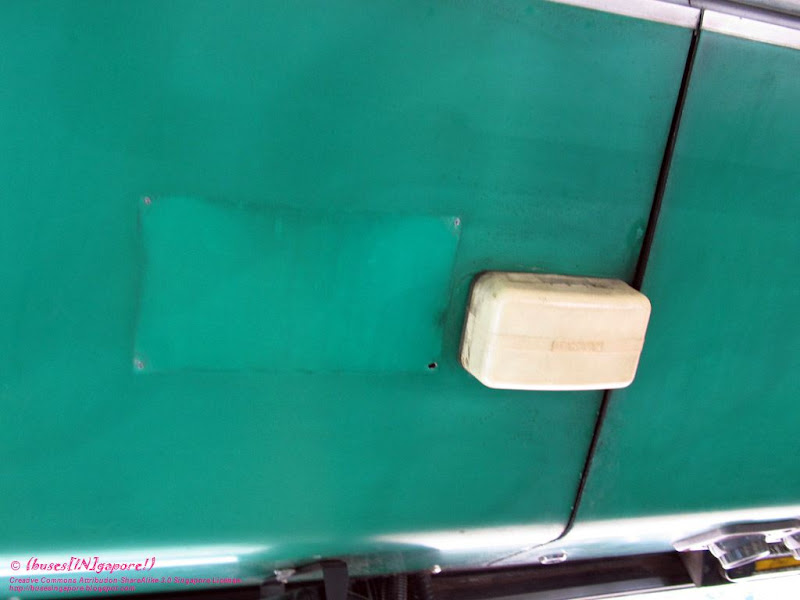
As it is not using the Lion's City Hybrid design, the first window after the driver cabin/entrance door has no sticker pasted on the left/right side of the windows.
 |
| Unlike the MAN NL323F A22, there's no sticker thing here as part of the Lion's City Hybrid bodywork design. |
Moving on to the middle, the articulator curtain accordion is translucent, allowing sunlight into the articulator section in the daytime. Hope they do keep it clean if not the translucent articulator would just be showing dirt and stuffs under the sunlight.
 |
| Translucent! |
 |
| Grab poles are installed on both sides of the articulator instead of a pole in the middle of the turntable. |
 |
| Another view of the translucent articulator - the shadow is the connector between the middle piece to the rear carriage. |
And towards the rear half of the bus.
It's the first bendy bus in Singapore to have rear facing seats at the rear half. Since the wheelchair bay & ramp is at the front half of the bus, there is seats opposite the exit door, and a divider pole for in the middle of the exit door. Apart from that, quite similar to the NL323F's rear half.
 |
| Deja vu, minus the wheelchair bay/space and foldable seat. |
 |
| View from the rear to the front - the divider pole can be seen at the exit door |
 |
| SMB388S's rear half seems to be longer than the Mercedes Benz O405G rear half. |
Overerall, the bus is about the same as the MAN NL323F A22, except it's longer and sounds different given it's equipped with a Voith gearbox. Anyone used to the lively ZF gearbox of the NL323Fs will feel odd when taking the NG363F for the first time due to the difference in gear changes when accelerating/cruising. Also, it has a weird handbrake sound or something.....not sure what's it about.
Comfort wise is expected from the NG363F - the NL323F itself is already a very comfortable bus. 'Nuff said, try it yourself! The Spheros aircon system feels cool but at times doesn't seem to cool very well until after a while.
 |
| SMB388S~ |
And given the success of the MAN NL323Fs, it is likely that there'll be production batch of the NG363F A24 but it remains to be seen though. Let's see SMB388S's journey for the next 17 years!
 |
| SMB388S turns out in style as it prepares to depart New Bridge Road Terminal~ |
![(buses[IN]gapore!)](https://blogger.googleusercontent.com/img/b/R29vZ2xl/AVvXsEhUpjEgfDeX7ZRuyhQk4VapcK_2fcn9NuFErwExXDh3UvvrxmuTXtE5VjYg4Itwh1lvuoc9GJov59Gp9pP8M4F4LTOlG9a5bOegFLroEieij6b4Yshorh7ks7cGVjxxaFwK9zE8dOtBpQ/s800/DSC_8122.jpg)